


Meditation as a Mirror into the Inner World
This may sound like a strange thing to say coming from someone who has devoted much of his life to practicing and teaching yoga, but that depends on what we mean by yoga.
If we’re speaking about yoga in its complete traditional sense, meditation is certainly a part of it. In fact, meditation stands close to the heart of what yoga was designed to accomplish. What’s incomplete isn’t yoga itself. It’s what yoga has commonly come to mean in the modern world, and that’s predominantly a physical practice centered on postures, movement, flexibility, strength, and bodily well-being.
Modern postural yoga can most certainly be profoundly beneficial. Skillful practice can strengthen and coordinate the body, improve posture and breathing, refine sensory awareness, and loosen the grip of habitual tension. Yet these changes are still only the beginning. Skillful physical sequencing can prepare the human system for clearer perception, but it doesn’t necessarily reveal the deeper patterns shaping our thoughts, emotions, choices, and relationships.
A well-designed physical practice can clear the mirror, but meditation teaches us how to look into it.
The Body Isn’t the Destination – It’s a Bridge to the Treasure
The two texts most often referenced to explain what yoga is and to map out a framework for achieving it are Patanjali’s Yoga Sutras and the Hatha Yoga Pradipika (HYP). Together they lay out the path, its challenges, the benefits we can expect along the way, and what becomes possible when yoga is realized.
The HYP makes the relationship especially clear. It presents haṭhayoga as a means toward rājayoga (the Highest Yoga). It insists that body, breath, and contemplative practice must all be practiced together.
Its earlier chapters develop the physical and energetic conditions that prepare us for deeper practice. Its later chapters move toward meditative absorption and increasingly subtle dimensions of being. Hatha Yoga isn’t presented as a destination of physical accomplishment, but as a means of making the contemplative ascent more accessible.
Postures, breath work, and meditation work together to support the achievement of yoga’s greatest treasures.
That’s part of why the body matters so much. It’s neither an obstacle to spiritual practice nor merely an object to perfect. It is the living instrument through which experience is received, organized, and expressed. When that instrument is burdened by unnecessary tension, poor coordination, fatigue, agitation, or deeply established defensive patterns, stillness becomes more difficult and perception is less clear.
The Yoga Sutras are fundamentally concerned with the mind: how its movements shape experience, how attention can be trained, how identification with mental activity can loosen, and how concentration develops into meditation and absorption. Asana appears within this system, but it isn’t the main subject or the final objective. It supports a path that moves inward.
This movement inward is explicit in the Yoga Sūtras. The eight limbs place āsana (postures) and prāṇāyāma (breath work) before concentration, meditation, and absorption. Prāṇāyāma is said to make the mind fit for concentration, while concentration, meditation, and samādhi (full absorption) are defined as progressively subtler forms of attention.
Our history doesn’t live only in the thoughts we can remember. It’s also seen in the way we stand, breathe, brace, collapse, move, protect ourselves, and also in the ways we respond to pressure. Repeated habits, injuries, emotional experiences, stress, and years of adaptation influence the organization of the body and nervous system. Over time, these patterns become so familiar that they no longer feel like patterns. They simply feel like us.
In this sense, the body carries some of the gravity of the past. The preparatory practices of yoga can begin to reduce some of that weight and interference. They can make the body steadier, the breath more available, and the internal landscape easier to perceive, creating more favorable conditions for meditation and the deeper benefits yoga offers.
Understanding the Limits of Asana Alone
At Zuna Yoga is designed to bring habitual patterns back into perception. We don’t use posture merely to create increasingly impressive shapes. We use it to develop coordination, strength, postural intelligence, sensory refinement, and a more skillful relationship with effort. We work to restore options lost through habit and reduce unnecessary tension, compensation, and interference.
Breath is fundamental to this process. Through asana, we develop the mobility, strength, and coordination required to create greater capacity for the breath and a more intelligent relationship between breathing and movement.
Yet breath is more than a physical function. It both reflects and influences our internal state. Agitation, fear, concentration, fatigue, and calm can all be reflected in the rhythm, depth, ease, and continuity of the breath. The breath is therefore where the physical and meditative dimensions of yoga begin to meet.
As posture creates greater freedom for respiration, attention can move more deeply into the experience of breathing itself. We’re no longer working only with the external shape of the body. We begin to observe how breath, sensation, attention, emotion, and mental state continually influence one another. Here, asana starts to become more than a physical practice: the body steadies, the breath refines, and awareness turns inward.
This is partly why our yoga teacher trainings devote substantial time to posture laboratories, movement skills, breathing mechanics, technique, sequencing, and practice teaching. The physical method matters. A teacher should understand what they’re asking a body to do, how a posture may support or restrict breathing, why they’re asking it, and how to guide another person intelligently.
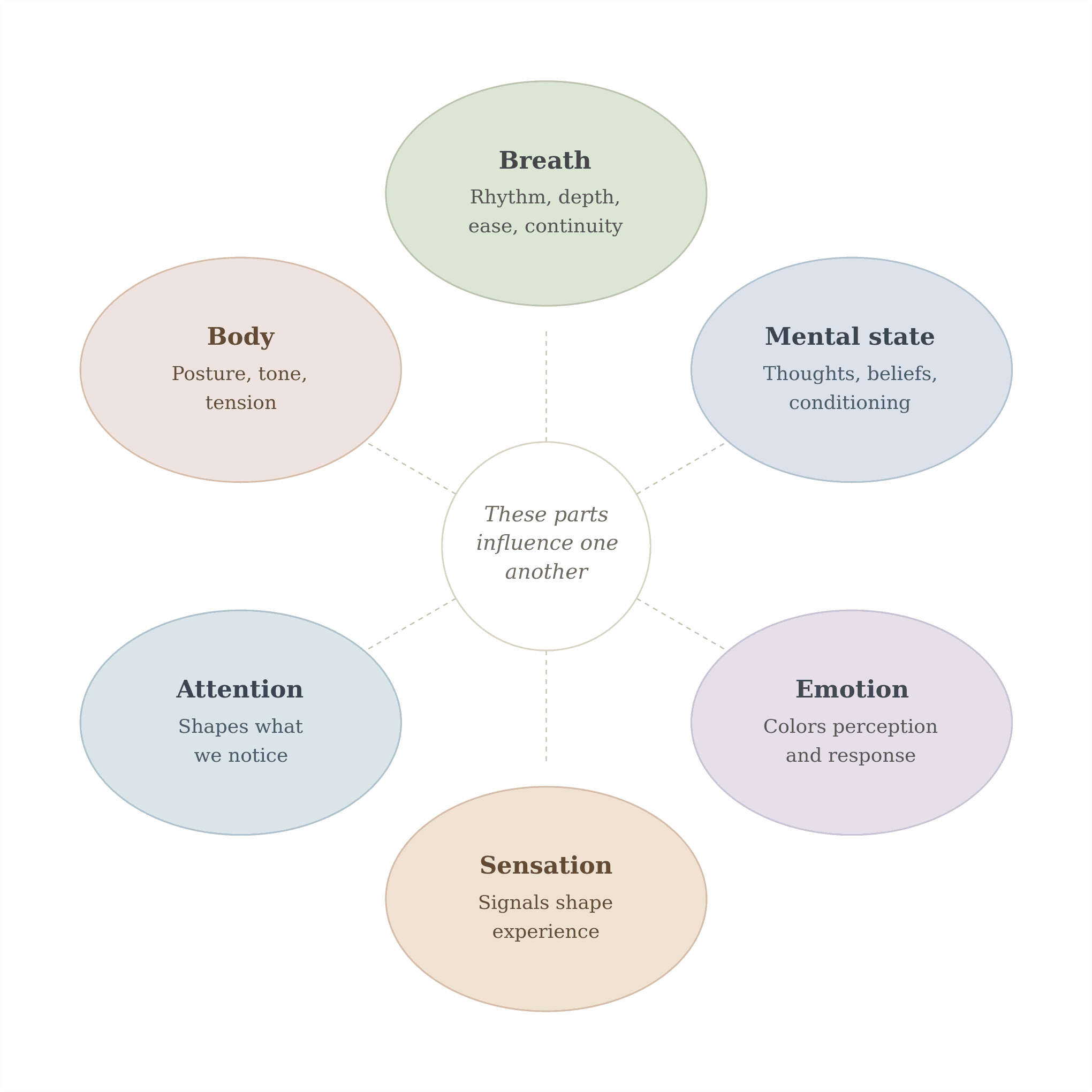
A well-designed practice can settle agitation, improve our ability to sense ourselves, expand our respiratory capacity, and create more favorable conditions for attention. It may loosen a habitual pattern before the practitioner understands what sustained it, how it shaped experience, or what function it may once have served.
But physical and respiratory change don’t automatically become conscious understanding. A person can become more flexible, stronger, and capable of breathing more freely without necessarily recognizing the deeper assumptions, emotional defenses, and automatic reactions shaping their lives.
This doesn’t diminish the value of asana. It clarifies its role. Somatic yoga refines the physical instrument; breath connects that instrument with attention and mental state; meditation develops the capacity to observe more directly how sensation becomes interpretation, thought becomes identity, and reaction becomes behavior and relationship.
Meditation is the Mirror
In my own years of practice and teaching, I’ve found nothing more revealing than meditation. I spent years in martial arts and yoga that was mostly physical, but I still struggled with the difficulties I’d carried since childhood. I felt haunted by my past. Even the various therapies I tried didn’t seem to have much effect. It wasn’t until I started taking meditation seriously that I began to see the disturbances and interference that were driving the destructive behaviors. That was a turning point for me. I no longer felt like a victim, and it gave me the agency I needed to shape my life the way I wanted.
Meditation isn’t a mirror because it confirms the person we already believe we are. It is a mirror because it allows us to observe how that person is being created. That gives us the ability to take creative steps and change what we once believed we just had to live with.
We begin to notice thoughts before they become words; emotional reactions before they become explanations; and the impulse to defend, pursue, withdraw, control, please, resist, or escape before it becomes behavior. Meditation gradually reveals the forces operating beneath the surface.
This doesn’t mean that every thought appearing in meditation is true. The mind produces fear, fantasy, memory, expectation, projection, and contradiction. What meditation can give us is a clearer view of the process through which reality is being interpreted.
We usually encounter our thoughts and reactions as though they’re direct descriptions of reality. Meditation helps us recognize that our thoughts are events arising within us. They may contain important information, but they may also carry fear, memory, expectation, and the residue of the past. With practice, we become better able to distinguish between what’s happening and what we’re adding to it. This is the beginning of seeing ourselves more clearly.
Seeing the World Through the Instrument of Ourselves
Life is relationship. We’re continuously relating to other people, our bodies, our thoughts, our responsibilities, our environment, our past, and our imagined future. When we can’t recognize our fear, we may call it intuition. When we can’t recognize our need for control, we may call it care. When we can’t recognize resentment, we may believe we’re simply seeing another person clearly.
We can’t completely separate the way we see the world from the condition of the system through which we see it.
A mind dominated by fear notices different information than a mind that feels safe. A person carrying unresolved anger may hear criticism where none was intended. Someone shaped by rejection may interpret distance as abandonment. We don’t encounter the world without filters. Body, nervous system, attention, memory, emotion, belief, past relationships: all of it shapes what we notice before we even notice it.
Meditation allows us to study the human instrument from within. It reveals not only what we perceive, but how perception is being shaped. That’s the real work meditation does for our relationships. It doesn’t tell us what to choose. It improves our ability to recognize the forces shaping choice.
Modern research doesn’t prove every traditional claim about meditation, and the results vary by method, duration, population, and quality of instruction. Still, systematic reviews suggest that structured meditation programs can produce modest average improvements in anxiety, depression, pain, and psychological distress (Goyal et al., 2014).
Researchers have also proposed attention regulation, body awareness, emotion regulation, and a changing perspective on the self as important mechanisms of mindfulness practice (Hölzel et al., 2011). A recent meta-analysis found a positive average effect on self-reported interoceptive awareness (the capacity to notice and relate to internal bodily experience) without implying that every sensation is accurate or should be accepted without question (Treves et al., 2025).
The body can be strengthened. The breath can become steadier. The nervous system can become more regulated. The weight of the past can begin to loosen. But eventually, we must become still enough to see what all of this preparation has made visible. Yoga prepares the instrument. Meditation teaches us how to look through it.
Ready to Step Through Your Mirror?
If any of this resonates, you don’t need to already call yourself a meditation teacher to belong in a room built around it. Our 300-Hour Meditation Teacher Training runs each October in Bali, built for dedicated practitioners and curious newcomers alike: 28 days at the base of Mount Batukaru, daily practice, a 3-day silent immersion, and the kind of depth a weekend workshop can’t offer.
This isn’t an invitation to reject physical yoga. It’s an invitation to remember where it can lead. See dates, pricing, and details for the next training →
Selected References
Patañjali. Yoga Sūtras 1.2–1.4, 2.29, 2.46–2.53, and 3.1–3.3.
Svātmārāma. Haṭha Yoga Pradīpikā 1.2, 2.76, and Chapter 4.
Kaṭha Upaniṣad 3.3–3.9 (the body as chariot, mind as reins, and discernment as charioteer).
Goyal, M., et al. (2014). Meditation programs for psychological stress and well-being: A systematic review and meta-analysis. JAMA Internal Medicine, 174(3), 357–368. doi:10.1001/jamainternmed.2013.13018.
Hölzel, B. K., et al. (2011). How does mindfulness meditation work? Proposing mechanisms of action from a conceptual and neural perspective. Perspectives on Psychological Science, 6(6), 537–559. doi:10.1177/1745691611419671.
Treves, I. N., et al. (2025). Minding the body: A meta-analysis of the effects of mindfulness meditation training on self-reported interoception. Scientific Reports, 15, 38889. doi:10.1038/s41598-025-22661-4.
