


Yoga and mental health have become increasingly important topics in today’s world. As a former public health researcher and now co-director of a yoga school, I find myself continually struck by the current state of mental health in our world.
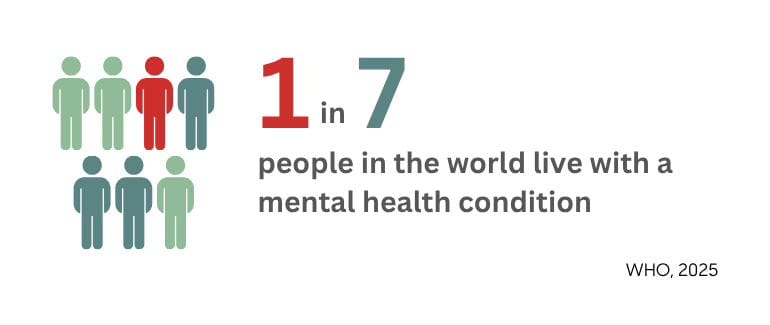
The numbers reported by the WHO are staggering: nearly 1 in 7 people worldwide are currently living with a mental disorder, with anxiety and depression among the most common conditions across all ages and backgrounds (World Health Organization, 2025). Behind these statistics are millions of people struggling with stress, disconnection, emotional exhaustion, and an increasing difficulty feeling at ease within themselves. Chronic stress has become one of the defining health challenges of our time, influencing both mental and physical well-being, with stress levels continuing to rise globally over recent decades (Piao et al., 2024).
How is it possible that we have become so technologically advanced, so intellectually capable, yet at the same time increasingly anxious, overwhelmed, disconnected, and mentally exhausted?
Perhaps part of the answer lies in the world we have created around us. We are constantly exposed to economic uncertainty, political tension, social media overload, endless notifications, chronic multitasking, and the relentless pressure to keep functioning no matter how overwhelmed we may feel inside. In this environment, honestly, how are we not losing our minds?
From my own experience, and from years of working with students, I have come to feel that many of us have lost balance, lost clarity, and ultimately lost ourselves in the noise. I have myself experienced periods where things slowly began slipping out of control, where I felt trapped in cycles of stress, negative thinking, and emotional exhaustion, without finding any real way out.
Ironically, despite working in health promotion and prevention research, I now realize how deeply I myself had been caught in the very system I was studying, while struggling to genuinely care for my own mental health. Nothing I tried to feel better seemed to create a deep or lasting shift.
Until I found yoga… And honestly, coming from a scientific background, the spiritual or mystical aspects often associated with yoga were not something that naturally attracted me. But despite my skepticism, the practice itself was undeniably effective, not only physically, but psychologically as well. This marked the beginning of a much deeper investigation on yoga and mental health: why was yoga having such a powerful effect, not only on me, but on so many other people as well?
Fortunately, over the last decade, science has increasingly begun exploring the relationship between yoga and mental health. As this month is dedicated to mental health awareness, it felt like the right moment to share some of this emerging research.
So take a deep breath… and enjoy the read.
Yoga and Mental Health: What Happens in the Brain?
Much of the recent research on yoga and mental health focuses on how regular practice influences brain regions involved in emotional regulation, attention, and stress resilience. In April 2026, a literature review published in Frontiers in Neuroscience summarized current knowledge on how yoga may influence brain structure and brain function in healthy individuals. The review included peer-reviewed studies using neuroimaging techniques such as MRI, fMRI, and EEG, comparing experienced yoga practitioners with non-practitioners, or measuring participants before and after yoga interventions (Stoelers et al., 2026).

After a rigorous screening process, 23 studies were included in the final review, involving participants ranging from complete beginners to practitioners with up to 30 years of experience. This allowed researchers to explore both short-term and long-term effects of yoga practice on the brain.
Overall, the review identified recurring structural and functional changes in brain regions involved in emotional regulation and stress processing. But what is particularly interesting is that the findings go beyond the simple idea that yoga merely “helps us relax.”
The review points toward possible changes in systems involved in attention, stress regulation, body awareness, and the way we relate to our thoughts and emotions. In other words, yoga may not only influence how we feel physically, but also how we experience ourselves internally.
The Nervous System and “Internal Noise”
One of the most interesting themes emerging from this research is the relationship between yoga and what we might call internal noise.
Several studies reported altered activity and connectivity within the Default Mode Network (DMN), a large-scale brain network involved in self-referential thinking, memory, imagination, emotional processing, and our ongoing internal narrative.
The DMN is now considered central to how we construct our sense of self (Azarias et al., 2025). Yet, when overactive or poorly coordinated, dysregulation within this brain network has been associated with rumination, anxiety, depression, chronic stress, attentional instability, and other neuropsychiatric conditions. Recent neuroscience research suggests that difficulties shifting and regulating DMN activity may play an important role in mental health disorders (Azarias et al., 2025).
Interestingly, yoga research suggests that meditation-based practices may reduce activity within certain parts of the DMN, particularly during meditative states. Studies on long-term practitioners, however, often point less toward a simple “deactivation” of the network and more toward a reorganization in how different regions within the DMN communicate with one another. For example, some EEG studies reported increased synchrony in frontal DMN regions alongside decreased synchrony in posterior regions. These changes were associated with subjective experiences such as calmness, slower thought speed, reduced mind-wandering, and greater mental simplicity.

Some studies also reported reduced activity in the amygdala, a region strongly involved in stress and fear responses. EEG studies additionally reported increases in alpha and theta brain wave activity, patterns often associated with internally focused attention and meditative states.

Taken together, these findings support an idea that is becoming increasingly important in neuroscience: mental health may depend not simply on “thinking less,” but on the brain’s ability to regulate and coordinate different mental and emotional processes more effectively. From this perspective, yoga may not be suppressing the mind so much as changing the way different systems involved in attention, emotion, self-awareness, and stress interact with one another over time.
Changing the Mind Through the Body
Another major theme emerging from the review was interoception: the brain’s ability to sense, interpret, and regulate the internal state of the body.
Across multiple neuroimaging studies, yoga practitioners showed structural and functional changes in brain regions involved in interoceptive processing. Several studies specifically reported changes in insular regions associated with body awareness, internal sensing, emotional regulation, and self-awareness.
This is particularly relevant because modern life constantly pulls attention outward. Under chronic stress, many people gradually lose sensitivity to the body’s internal signals, including breathing patterns, muscular tension, fatigue, emotional activation, and physiological stress responses.

Yet the body is a sensory system, continuously sending streams of information arising from the breath, heart, muscles, posture, organs, and autonomic activity to the brain. The more clearly we perceive those internal signals, the easier it becomes to respond with awareness rather than react automatically to stress and daily challenges.
This is important because interoceptive impairments at different levels have been linked to multiple physical and mental health conditions, including fatigue, depression, eating disorders, anxiety, and autism spectrum conditions (Quadt et al.,2018). In this sense, mental health may depend not only on how we think, but also on how accurately we perceive and regulate internal physiological signals. Practices that strengthen interoceptive awareness may therefore support emotional regulation, stress awareness, and self-regulation over time.
This may be where some of yoga’s deeper mental health benefits lie: not simply in changing the mind directly, but in restoring sensitivity to internal experience and strengthening the way we regulate and respond to stress.
More Than Relaxation
At the same time, the authors are careful to point out that this field of research is still evolving. The findings across studies were not always identical, and several factors likely influence the results, including the style of yoga practiced, the duration and intensity of practice, participants’ years of experience, and differences in research methodology.
This is important because yoga is not a single, uniform practice. Some approaches emphasize physical postures, others breathing, meditation or relaxation. It is therefore unlikely that all forms of yoga influence the brain in exactly the same way. Still, despite these limitations, a broader pattern clearly emerges across the research: yoga may help improve the way the nervous system regulates stress, attention, emotion, and internal awareness over time. Many of these benefits are explored further in our 200hour Yoga Teacher Training and 300hour Yoga Teacher Training.
From a public health perspective, this is perhaps what I now find most fascinating about yoga and mental health. We are living through a time where chronic stress, emotional exhaustion, and lifestyle-related diseases are becoming increasingly common across the world. And yet, many of us have lost simple practices that help us slow down, reconnect with ourselves, regulate stress, and feel more at ease in our own minds and bodies.
I am not saying yoga is a miracle cure, nor that it can replace medical or psychological care. But I do believe that accessible practices which help people breathe better, become more aware of themselves, regulate emotions, and navigate stress in healthier ways may have an important role to play in the prevention and management of both mental and physical health challenges.
References
Azarias, F. R., Almeida, G. H. D. R., de Melo, L. F., Rici, R. E. G., & Maria, D. A. (2025). The journey of the default mode network: Development, function, and impact on mental health. Biology, 14(4), 395. https://doi.org/10.3390/biology14040395
Piao, X., Xie, J., & Managi, S. (2024). Continuous worsening of population emotional stress globally: Universality and variations. BMC Public Health, 24(1), 3576. https://doi.org/10.1186/s12889-024-21117-7
Quadt, L., Critchley, H. D., & Garfinkel, S. N. (2018). The neurobiology of interoception in health and disease. Annals of the New York Academy of Sciences, 1428(1), 112–128. https://doi.org/10.1111/nyas.13915
Stoelers, L., Arias-Sánchez, S., Domínguez, P., & Martín-Monzón, I. (2026). How yoga shapes the brain: A systematic review. Frontiers in Neuroscience, 20, 1718808. https://doi.org/10.3389/fnins.2026.1718808
World Health Organization. (2025). Mental disorders. World Health Organization. https://www.who.int/news-room/fact-sheets/detail/mental-disorders
