
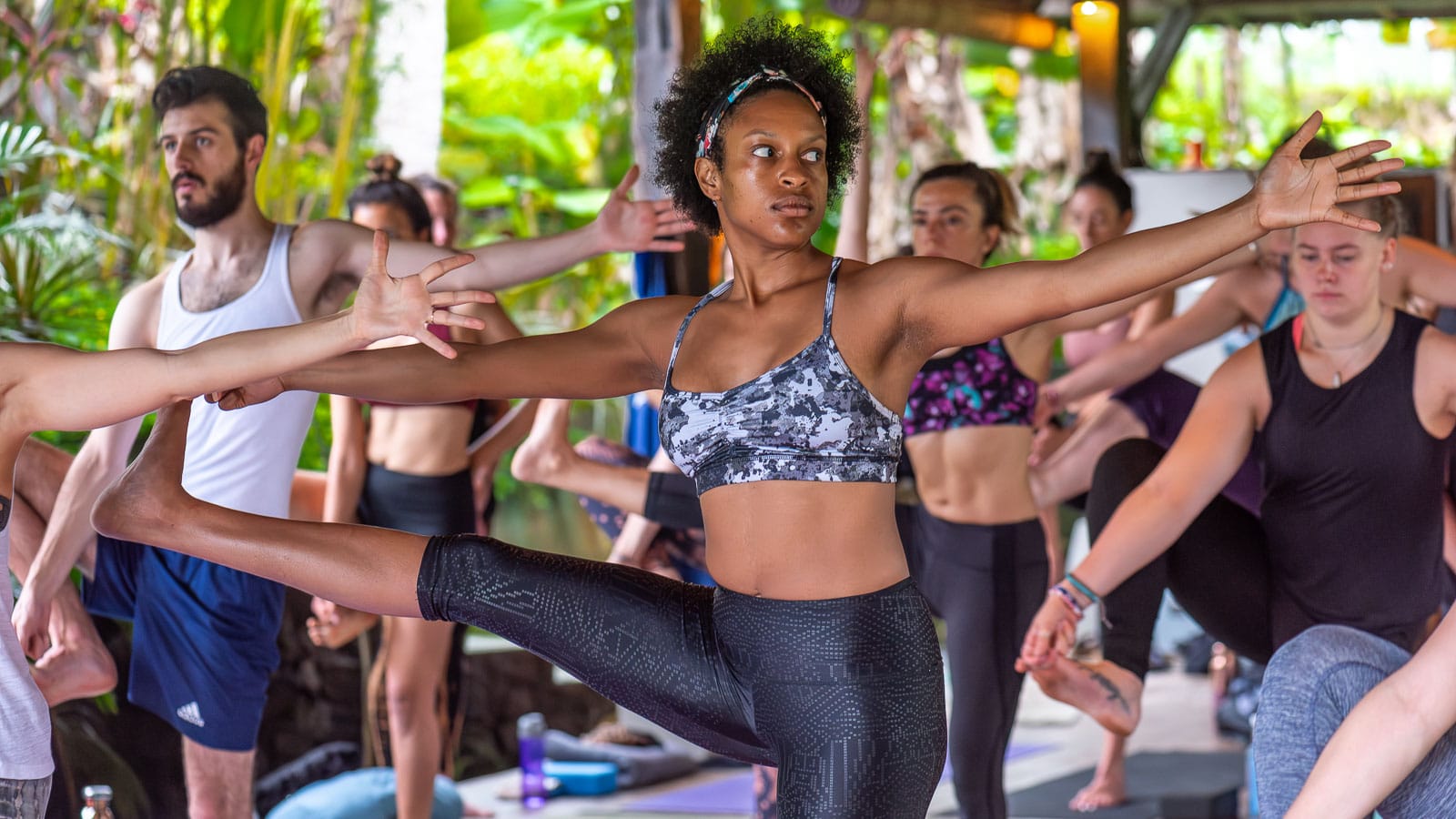

At Zuna Yoga, balance over force in yoga is a foundational principle of our method. We train practitioners to distribute effort across the whole body, to prioritize stability over strain, and to allow strength to emerge from coherence rather than tension. When body, breath, and attention are aligned, strength expresses itself with greater ease. This principle of balance over force in yoga shapes how we train stability, strength, and attention in every practice.
This has important implications not only for how we hold postures, but also for how we meet challenges more broadly. When balance is compromised physically or mentally perception narrows, coordination deteriorates, and effort becomes scattered. Pushing harder in these moments often reinforces instability rather than resolving it.
In this blog, we explore how decades of neuromuscular research support the way Zuna Yoga approaches practice. Research shows that stability is not simply a matter of strength, and that increasing effort does not necessarily improve control. In many situations, force becomes more effective when it is better regulated rather than amplified.
Force Is a Neural Process
Understanding force as a neural process helps clarify why balance over force in yoga leads to greater stability and less strain.
If you have ever held a yoga posture for more than a few breaths, you may have noticed that it does not simply become harder because the muscles get tired. Instead, the quality of effort changes: stability comes and goes, and subtle adjustments seem to matter more than raw strength.
When we talk about strength in yoga, it’s easy to think only about muscles. But muscles don’t act on their own. Every bit of force we produce is organised by the nervous system. A muscle doesn’t contract as one solid block. Each contraction is built from many smaller pieces, called motor units, small groups of muscle fibres that are switched on by a nerve signal.
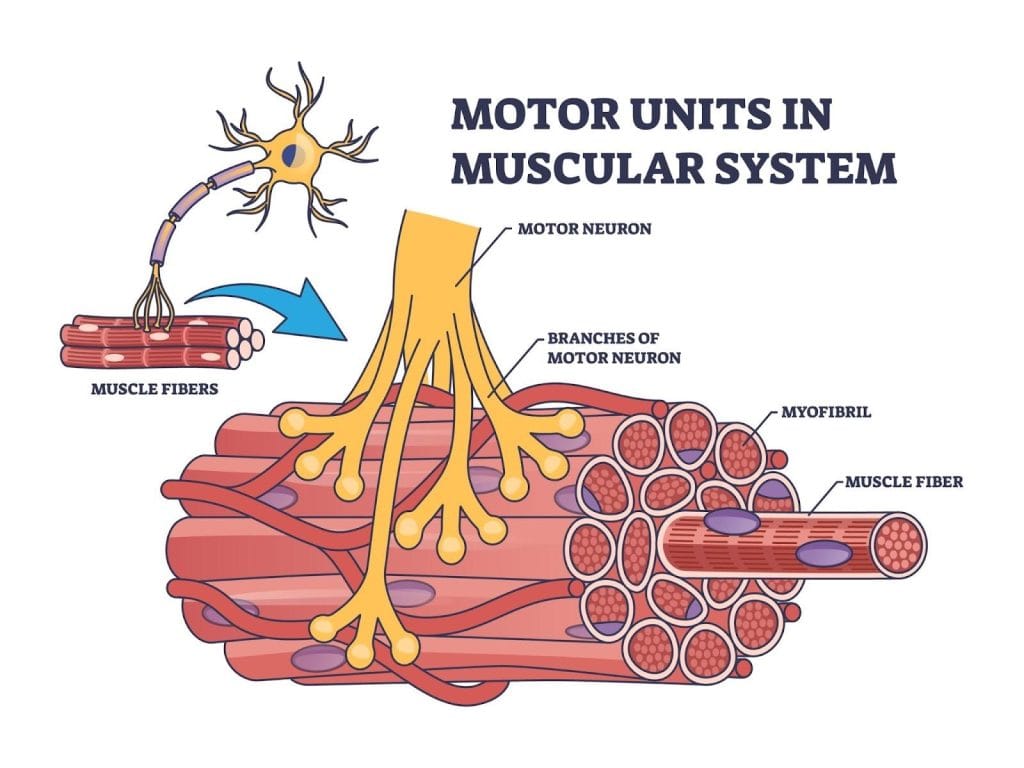
The nervous system determines how much force is produced by deciding how many motor units are recruited and how frequently they are activated. The latter, how often those signals are sent, is called firing rate. At lower effort, force increases mainly through recruitment. As demands rise, changes in firing rate play a larger role.
Decades of research on neuromuscular control show that early increases in force come primarily from recruiting more motor units. As effort rises and fewer new units remain to be recruited, the nervous system relies increasingly on firing rate to generate additional force. Force, then, is not a fixed property of tissue; it is continuously regulated by the nervous system in response to task demands, sensory feedback, and context.
Strength and steadiness are two different qualities
Strength = how much force the neuromuscular system can produce at its maximum.
Steadiness = how precisely that force can be regulated over time.
Even when a posture looks completely steady from the outside, force inside the body is never perfectly constant. It fluctuates subtly around an average value, like the surface of a lake that appears calm but is always in motion.
Researchers describe the smoothness of these fluctuations as force steadiness, a key element of balance and stability in yoga. One of the most robust findings in neuromuscular research is that force steadiness depends far more on how the nervous system organises muscle activity than on how strong a muscle is. (Enoka & Farina, 2021).
This is easy to recognise in yoga practice. In a standing balance posture, such as Tree Pose or any one-legged stance, low force steadiness often shows up as over-correction. Contact with the ground becomes uneven, pressure collapses into parts of the foot, the toes begin to claw, the ankle stiffens, and the body sways excessively. The posture is being held, but it feels noisy and unsettled.
When force steadiness improves, contact with the ground becomes clearer rather than stronger. Pressure is distributed across the whole sole of the foot. The leg supports the body without locking, and the body sways only minimally. Small adjustments still occur, but they are coordinated rather than abrupt. In both cases, the amount of force being produced may be similar. What changes is the quality of how that force is organized.
Why More Effort Often Reduces Stability
At a basic level, the nervous system has two ways to increase force.
- One option is fine control. Here, motor units receive slightly different signals, allowing force to be adjusted in small, independent increments. This strategy supports smooth, precise force production and good force steadiness.
- The other option is broadcast control. Instead of fine-tuning individual motor units, the nervous system sends one strong, shared signal to many motor neurons at once. This approach is efficient and effective for generating force, but it comes at the cost of precision. Researchers refer to this shared drive as common synaptic input.
To understand how this works, imagine each motor neuron as a lightbulb. With fine control, each bulb has its own dimmer. Some brighten slightly, others dim, and their small fluctuations tend to cancel each other out. The overall light stays steady.
With common synaptic input, many bulbs are connected to a single dimmer. When that dimmer moves, all the bulbs brighten or dim together. This is efficient, but far less subtle. Any small fluctuation in the signal is shared across many motor units at once.
Because the shared signal is never perfectly constant, these fluctuations add up rather than cancel out. Force rises and falls in larger, synchronised waves instead of tiny, independent adjustments. As effort increases or is sustained, the nervous system naturally shifts toward this strategy because it is economical.
As effort increases or is sustained, sending many individual control signals becomes costly and slow. Broadcasting one strong signal is faster and more efficient. As a result, higher force demands naturally shift control toward common synaptic input. This is why balance over force in yoga is not about doing less, but about organising effort with greater precision.
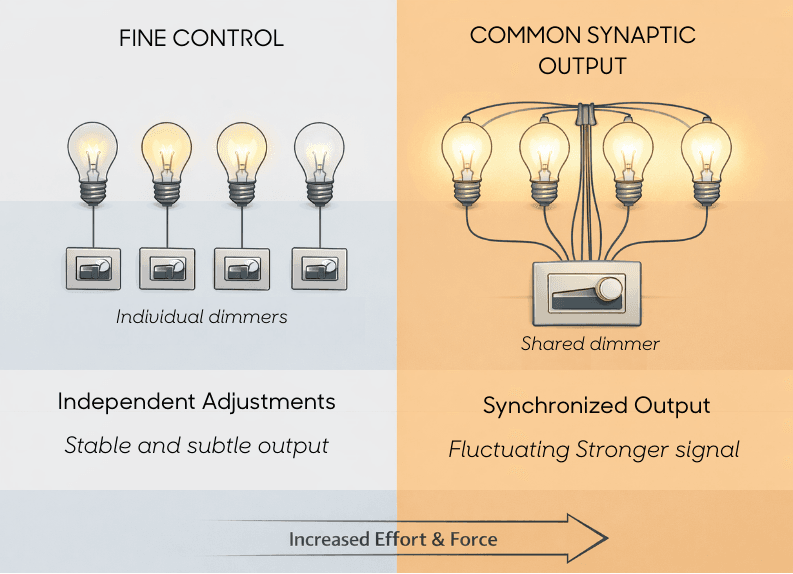
That is why more force often means less precision — and why excessive effort can reduce stability in yoga postures.
In the body, this shift is felt as shaking, wavering, over-correcting, gripping, or bracing. These sensations are not signs of weakness. They reflect a nervous system that is driving too many motor units together in an attempt to maintain control.
This helps explain a familiar experience in yoga practice. When effort is reduced slightly, the nervous system can return to more independent control. Fewer motor units are locked together, fluctuations shrink, and steadiness improves. Trying harder often makes balance worse not because less is happening, but because control has become too coarse.
Instability Creates Fatigue
From the nervous system’s perspective, instability dramatically increases the need for continuous correction. Motor unit firing rates decline more rapidly, necessitating the recruitment of additional motor units. The system works harder not because more force is required, but because maintaining control becomes more demanding.
Instead of sustaining a steady, economical pattern of activation, the nervous system is forced into constant adjustment and compensation. Over time, this leads to earlier exhaustion, even when the external force being produced remains unchanged.
This helps explain why alignment, balance, and support matter so much in sustained yoga postures. They reduce the regulatory load on the nervous system, allowing force to remain organised with less effort and less fatigue. Stability does not make practice passive. It makes it more sustainable.
Stability Is a Sensory–Motor Process
The nervous system does not regulate force in isolation. How steady a posture feels depends just as much on sensory information as on motor output. Vision, proprioception, and vestibular input continuously inform the brain about position, orientation, and movement, shaping how precisely force can be organised over time.
Research on core stability and balance shows that very low levels of muscular activation, often less than 10% of maximum, are sufficient to stabilise the spine, provided timing and coordination are intact (Borghuis, Hof & Lemmink, 2008). Reduced balance, by contrast, is commonly associated with delayed or less effective activation of stabilising trunk muscles when sensory input is challenged.
In this context, research on core stability and balance shows that very low levels of muscular activation, often less than 10% of maximum, are sufficient to stabilize the spine, provided timing and coordination are intact (Borghuis, Hof & Lemmink, 2008). Reduced balance, by contrast, is commonly associated with delayed or less effective activation of stabilising trunk muscles when sensory input is challenged. Such as: when proprioceptive feedback is unclear, visual reference is reduced, or support becomes unstable.
The issue is not a lack of strength, but a loss of anticipatory control. Instead of stabilising before movement occurs, the system is forced into reactive corrections, which feel effortful, noisy, and unstable. From this perspective, balance over force in yoga emerges when perception, timing, and coordination are clear.
This reframes stability not as something we achieve by pushing harder, but as a sensory–motor process governed by the nervous system. It also supports a core principle we emphasise at Zuna Yoga: maximal effort is rarely required for stability and is often counterproductive. What matters is the organization of effort, timing, distribution, and the quality of sensory regulation that becomes available when we take the time to breathe, feel the body, and allow the nervous system to organize itself.
This principle of balance over force in yoga not only defines our approach on the mat but guides how we balance effort with sensory awareness.
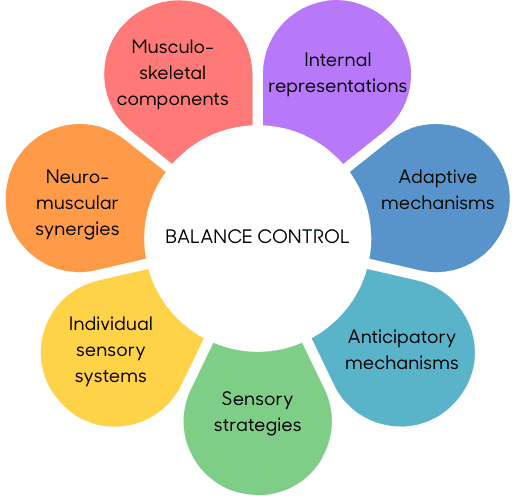
Conceptual model representing the many components of postural control (redrawn from Shumway-Cook and Woollacott, 2012).
When Stability Turns into Bracing
When the nervous system senses uncertainty, even in the absence of real danger, it can shift into a protective, high-alert state driven by increased sympathetic nervous system activity. This often expresses itself physically as bracing.
Bracing is a strategy of anticipation. The body prepares for potential stress by increasing muscle tone and co-contracting opposing muscle groups. Movement becomes reduced, joints feel held or stiff, and the breath often becomes shallow or momentarily restrained. These changes can create a temporary sense of control, but they also increase effort and fatigue.
Novel postures, balance challenges, sustained effort, or uncertainty about support can be enough to trigger it. The nervous system acts pre-emptively, prioritising protection over efficiency.
While bracing can be useful in moments that genuinely demand rapid stabilisation, it becomes counterproductive when it becomes habitual. In sustained postures and slow practice, stability depends less on defence and more on coordination, sensory clarity, and regulation. Repeated exposure allows the nervous system to recalibrate threat prediction and reduce unnecessary sympathetic activation. As practice refines perception and restores trust in support, the system can gradually shift away from high-alert tension toward a more economical and responsive form of stability.
Why Balance Becomes Harder With Age
Research reviewed by Enoka and Duchateau shows that aging is associated with reduced firing rate and increased force variability, particularly at low force levels. This means that older adults are not simply weaker. Rather, the nervous system becomes less capable of regulating force smoothly and precisely.
These neural changes interact with age-related alterations in sensory processing and reaction speed. Together, they help explain why balance often declines with age even when strength loss is modest. Standing, walking, and responding to small disturbances all depend on steady, low-level force control, the very domain most affected by changes in neural organization. In this regard, a recent systematic review and meta-analysis found that force steadiness is closely linked to functional performance in older adults, highlighting its importance for balance, walking, and everyday movement (Camacho-Villa et al., 2025).
Training the Nervous System: Balance Over Force in Yoga
Balance challenges are not merely musculoskeletal. They are fundamentally neural and sensory–motor. How we move over weeks, months, and years reshapes how motor neurons behave. Periods of inactivity can significantly reduce the nervous system’s capacity to modulate force, sometimes accounting for substantial performance loss even before measurable changes in muscle tissue occur.
When practice prioritizes balance, clear sensory input, regulated effort, and time to breathe and feel the body, it actively reshapes how force is organized. Over time, this trains the system to use the body with greater precision, steadiness, and efficiency.
A Final Thought
Zuna Yoga emphasizes performing postures and techniques with fluidity and ease, even when the demands are significant. This is not about avoiding challenge, but about engaging intelligently. By prioritizing balance over aggression, the practice invites a different relationship to effort, one in which steadiness, adaptability, and self-mastery replace strain.
Stability, as modern neuromuscular research makes clear, is a neural and sensory–motor skill. By working at moderate intensity, emphasizing whole-body organization, and prioritizing balance and support, the practice creates conditions in which effort is distributed rather than concentrated, neural noise decreases, and steadiness can arise. As this shift occurs, attention naturally moves inward. Breath, sensation, and subtle balance matter because they directly influence how force is organized. The focus of practice moves away from producing more force and toward refining how force is regulated.
From this perspective, Hatha Yoga and the way it is expressed in Zuna Yoga, is not a low-effort practice, but a precision practice. At the core of our method, the principle of balance over force in yoga is not merely philosophical idea; it reflects how the nervous system organizes stability most effectively.
REFERENCE
