

Pelvic floor awareness is an essential yet often overlooked aspect of movement, breathwork, and yoga practice. In Zuna Yoga, we frequently refer to these muscles—whether in cues for Mula Bandha, deep core activation, or during breathing practices and meditation. However, many students, especially women, report uncertainty about whether they are engaging the pelvic floor correctly.
Scientific research supports this confusion. Even women who have received clear instructions about the pelvic floor often find it difficult to isolate these muscles or distinguish their contractions from those of surrounding areas. Understanding pelvic floor awareness can greatly enhance your movement practices and overall heath. This post aims to clarify what the pelvic floor is, its role in health, highlight common mistakes made during pelvic floor muscle exercises, and offer practical tips for more effective engagement.
What Is The Pelvis ?
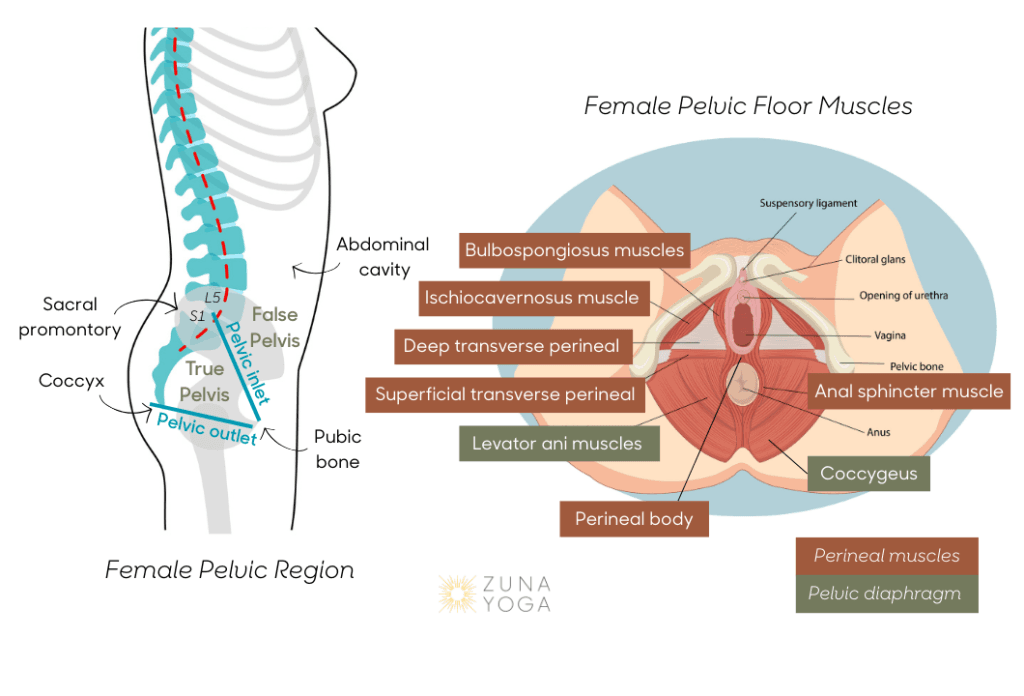
The pelvic region is the lower part of the trunk, nestled between the abdomen and the thighs. It is a complex anatomical zone, where the interplay of various pressures (visceral, muscular, and fluid) plays a key role in maintaining the proper function of the organs it supports. The pelvic region is composed of:
1. The pelvic girdle
This is the solid ring of bones that forms the structural base of the spine and supports the organs above. It’s made up of the sacrum and coccyx at the back, and the two hip bones on each side—each formed by the ilium, ischium, and pubis. This bony basin provides protection for internal organs and anchors key muscles involved in movement and stability.
2. The pelvic cavity
Anatomically, the pelvic cavity is bordered above by the pelvic inlet—an imaginary line stretching from the pubic bone to the top of the sacrum—and below by the pelvic outlet, which extends from the pubic bone to the tip of the coccyx. This cavity supports essential pelvic organs such as the bladder, rectum, and in women, the uterus and upper part of the vagina. Above the pelvic inlet lies the false pelvis (also called the greater pelvis), which is typically considered part of the abdominal cavity, as it supports abdominal (not pelvic) organs.
3. The pelvic floor
The pelvic floor is the multi-layered muscular and fascial foundation at the base of the pelvis that supports the organs, stabilises the core, and adapts to pressure changes during breathing and movement. It includes:
- A deep layer: the pelvic diaphragm, made up of the levator ani and coccygeusmuscles, which supports the pelvic organs from within the cavity. The pelvic diaphragm separates the pelvic cavity from the perineum.
- A superficial layer: the perineal muscles and fascia, located just below the diaphragm, involved in functions like continence, sexual activity, and stability. Located just below the pelvic floor, the perineum is a diamond-shaped area stretching from the pubic bone to the tailbone, and between the two sitting bones. It includes both superficial and deeper layers of muscle and fascia. Of important note, the term perineum sometimes refers specifically to the area between the genitals and the anus. This central region is also called the perineal body.
Functional Anatomy: Pelvic Compartments
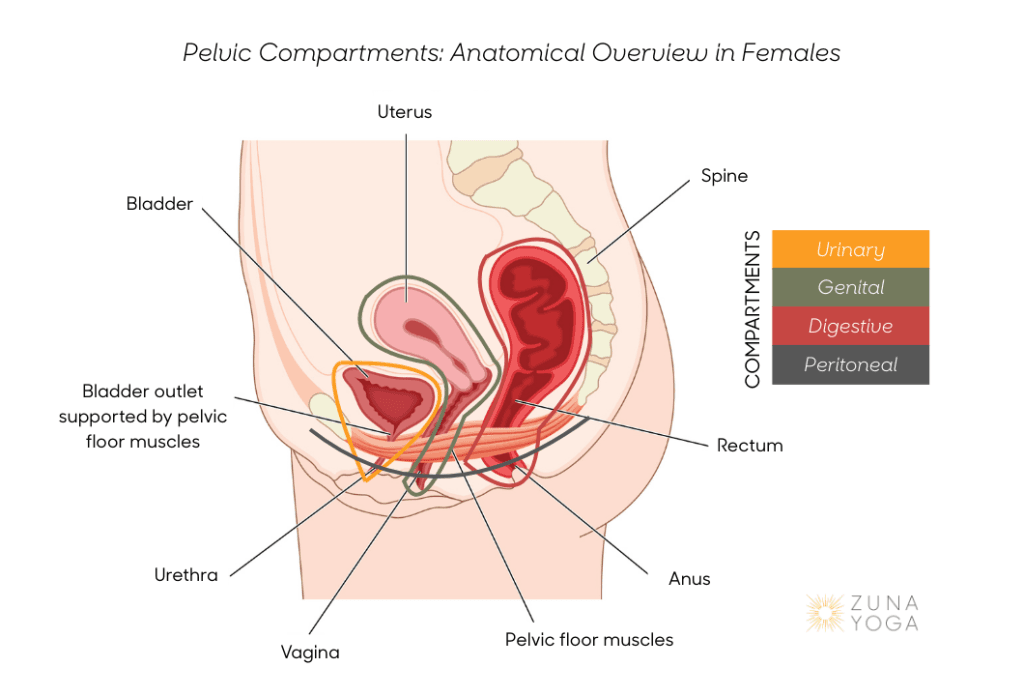
Anatomically, the pelvis can be divided into four functional compartments, each associated with different organ systems and functions:
- Anterior (Urinary) Compartment: This contains the bladder, bladder neck, and urethra—structures involved in urine storage and elimination.
- Middle (Genital) Compartment: In women, this includes the vagina and uterus; in men, the prostate. These organs play key roles in reproduction, hormonal signaling, and sexual health.
- Posterior (Digestive) Compartment: Home to the rectum, anal canal, and part of the sigmoid colon, this compartment governs the final stage of digestion and elimination.
- Peritoneal (Fascial) Compartment: Composed of the endopelvic fascia and the perineal membrane, this layer provides essential structural support and helps suspend the pelvic organs, acting as a bridge between the organs and the musculoskeletal system.
This functional classification is especially valuable in the context of yoga and movement practices. It shows how engaging the pelvic floor muscles properly can play a powerful role in maintaining the health of our urinary, reproductive, digestive, and fascial systems—contributing to overall health and well-being.
Common Mistakes in Pelvic Floor Muscle Engagement
The International Continence Society (ICS) defines normal pelvic floor muscles as:
“A situation in which the pelvic floor muscles can voluntarily and involuntary contract and relax. Voluntary contraction will be normal or strong and voluntary relaxation complete. Involuntary contraction and relaxation are both present.” (Messelink et al., 2005)
This definition highlights that both contraction and relaxation phases are essential components of a healthy, functional pelvic floor. Yet, many women are unsure how to properly contract their pelvic floor muscles when instructed to do so. While it might seem like a simple action, research shows that around 30% of women don’t engage these muscles correctly—even after instruction. This challenge is understandable: the pelvic floor is a complex structure, and achieving accurate neuromuscular control often requires clear guidance and practice.
Common compensation patterns or errors during attempted pelvic floor muscle activation include (Neels et al., 2018; Bø et al., 2015):
- Engaging the glutes, inner thighs, or abdominal muscles instead of the pelvic floor
- Holding the breath or overemphasizing inhalation
- Bearing down (which pushes the pelvic floor downward) rather than lifting it upward
These compensations can create the sensation of effort without actually engaging the deep pelvic musculature. Over time, such habits may even increase intra-abdominal pressure, potentially worsening symptoms in individuals with pelvic floor dysfunction.
Pelvic Floor Dysfunction
Pelvic Floor Dysfunction (PFD) is an umbrella term that refers to a range of symptoms and impairments caused by the inability of the pelvic floor muscles to properly contract, relax, or coordinate. It can affect people of all genders and often has a significant impact on quality of life—physically, emotionally, and socially.
While often overlooked or misunderstood, PFD is more common than many realise. According to the National Institutes of Health (Nygaard et al., 2008), nearly 24% of women in the United States report at least one symptom of a pelvic floor disorder, such as urinary incontinence, fecal incontinence, or pelvic organ prolapse. These numbers increase with age, with up to 50% of women over the age of 80 experiencing symptoms. Men are also affected, particularly following prostate surgery (post-prostatectomy incontinence) or when experiencing chronic pelvic pain syndrome.
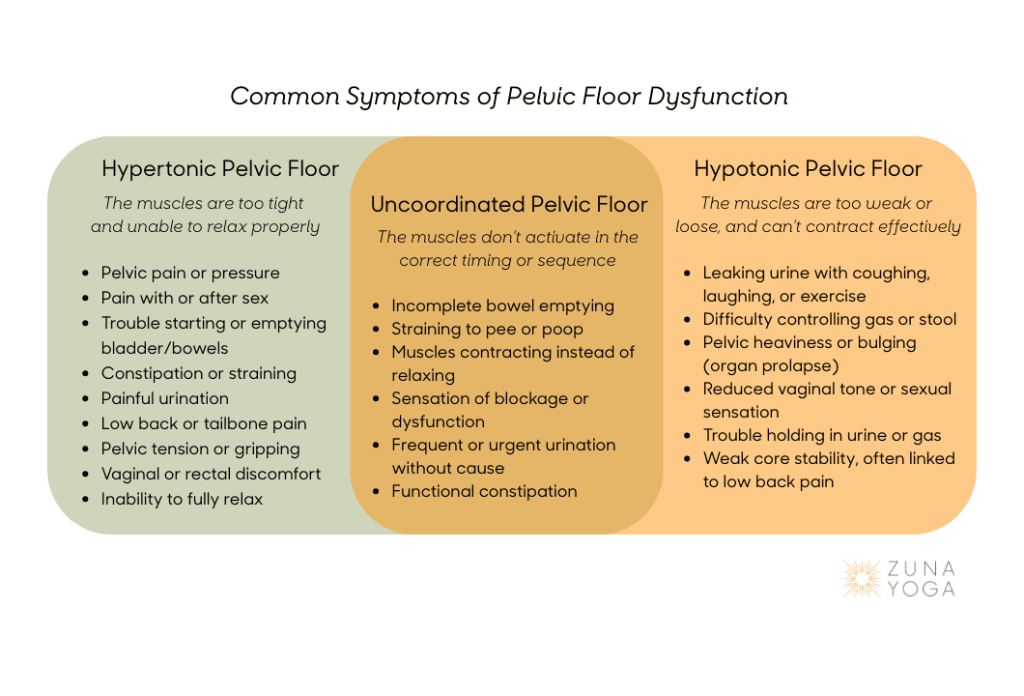
It is important to practice with awareness to improve engagement. PFD can present in different forms, depending on the tone and coordination of the pelvic floor muscles. The dysfunction is typically categorized into three main types:
- Overactive (Hypertonic) – muscles are too tight or cannot fully relax
- Underactive (Hypotonic) – muscles are weak or lack tone
- Uncoordinated – muscles do not engage in a timely or functional way
Each type can produce a distinct set of symptoms:
Fitness ≠ Healthy Pelvic Floor
When we think about building strength and stability, physical activity is often the first thing that comes to mind. But when it comes to the pelvic floor, simply being active isn’t always enough—and in some cases, it might even create imbalances if we’re not mindful.
Research shows that pelvic floor dysfunction is surprisingly common among female athletes, especially those in high-impact sports like gymnastics or long-distance running. Indeed, repetitive strain and elevated intra-abdominal pressure can overload the pelvic floor, leading to dysfunction—even in people who are otherwise strong and fit (Rivalta et al., 2010; Thyssen et al., 2002).
Recognizing the signs of PFD is crucial for effective treatment. This is where yoga offers something unique: a more nuanced, conscious approach to pelvic floor awareness and function. In yoga, we’re not just working the muscles, we’re cultivating refined neuromuscular control, breath awareness, and subtle energetic engagement.
Mula Bandha: The Subtle Power at the Root
In the yogic tradition, Mula Bandha—a Sanskrit term meaning “root lock”—is a foundational energetic practice involving the subtle engagement of the pelvic floor muscles. It is closely linked to the Muladhara chakra, the root energy center associated with grounding and stability. By engaging Mula Bandha, we channel energy upward from the base of the spine.
But what exactly are we engaging?
Ancient yogic texts describe Mula Bandha as a contraction of the perineum and anus:
“Pressing the perineum/vagina with the heel and contracting the rectum so that the apana vayu moves upward is Moola Bandha.” — Hatha Yoga Pradipika
“Press with the heel of the left foot the region between the anus and the scrotum, and contract the rectum; carefully press the intestines near the navel on the spine; and put the right heel on the organ of generation or pubes. This is called Mulabandha, destroyer of decay.” — Gheranda Samhita
Traditionally, Mula Bandha is linked to the energetic root of the body, located at the center of the perineum. From an anatomical perspective, this action primarily engages the pelvic diaphragm, with a key focus on the pubococcygeus muscle—one of the three muscles comprising the levator ani group. The pubococcygeus stretches from the pubic bone to the coccyx and plays a crucial role in supporting pelvic organs, maintaining continence, and facilitating voluntary pelvic floor contractions. Its central position and responsiveness to subtle activation make it especially relevant to the refined engagement required in yogic practices. Mula Bandha also involves the connective tissues of the perineal body, the fibromuscular node situated between the anus and genitals, which serves as a convergence point for several pelvic floor muscles and provides structural and energetic stability. The exact point of contraction for Mula Bandha differs slightly between men and women :
- In men, Mula Bandha is experienced as a contraction of the muscles surrounding the perineal body. Some texts recommend stimulating this contraction by applying gentle pressure under the perineum—using a soft, rolled-up sock or a specially designed cushion. Traditional postures, such as sitting with one heel pressing into the perineum, serve a similar purpose.
- In women, the contraction of Mula Bandha is often described as being felt deeper within the pelvis, around the base of the cervix. As with men, gentle pressure under the center of the perineum may help stimulate the engagement.
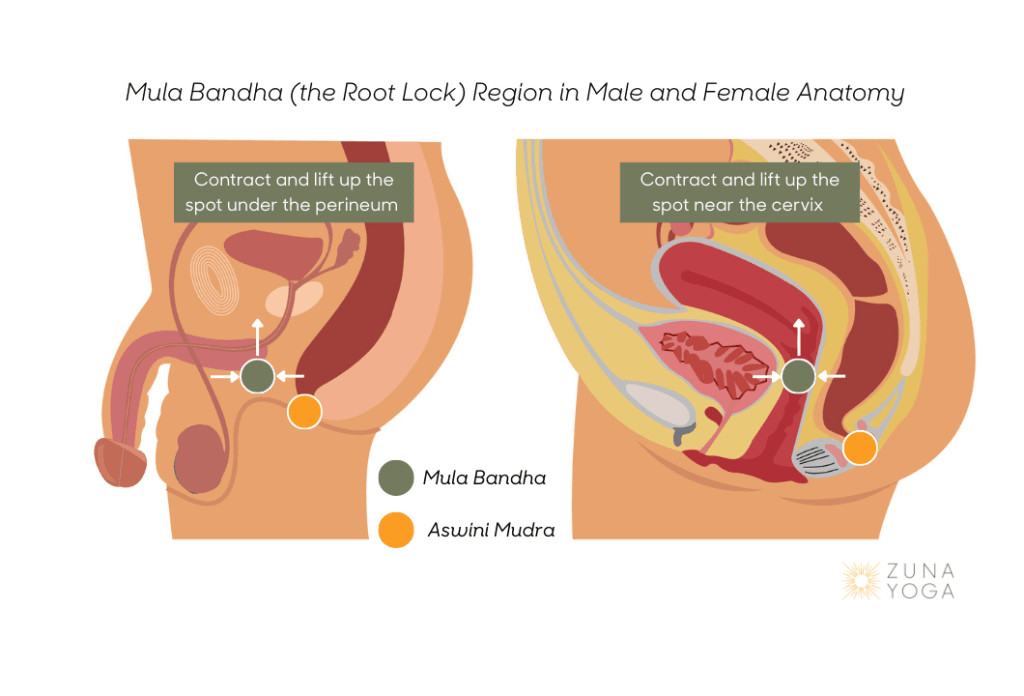
So what about squeezing the anus… Does that count as Mula Bandha? The contraction and relaxation of the anal sphincter is traditionally referred to as Ashwini Mudra, which is distinct from Mula Bandha. While the two may feel similar at first, their purpose and depth differ. Mula Bandha can be practiced at various levels of engagement, from gross muscular activation to more refined, subtle energetic lifts.
- Level One: Gross Engagement. Most practitioners begin here. This involves a broad contraction of the pelvic floor—lifting the entire perineal region including both urethral and anal sphincters, and even the lower belly. This level builds initial awareness and strength, serving as a foundation for more refined control. Imagine a gentle, inward and upward lift of the pelvic bowl. Be however mindful to avoid overusing the glutes or tensing the inner thighs.
- Level Two: Subtle Inner Lift. Over time, the practice becomes more refined. Focus shifts to the perineal body, a small yet central point at the heart of the pelvic floor. The engagement becomes lighter, more energetic than muscular, and is often practiced in tandem with breath and awareness in meditation. Rather than gripping, this level of Mula Bandha feels like a delicate inner lift—as if the body draws upward effortlessly, from within.
Zuna Yoga Tips for Engaging the Pelvic Floor Effectively
In the Zuna Yoga approach, we place great emphasis on mindful, intelligent engagement of the pelvic floor—recognising that strength without awareness can lead to dysfunction, and that subtlety often yields more than force. Whether you’re working with pelvic floor issues or simply looking to enhance your practice, these tips offer a powerful foundation.
1. Start with the Breath
As explored in our previous blog, Breath Awareness in Yoga – Part 1, the breath and pelvic floor are intimately linked. On inhalation, the pelvic floor naturally softens and expands; on exhalation, it gently lifts. Tuning into this rhythm not only trains pelvic floor responsiveness, but also improves breathing mechanics and activates the parasympathetic nervous system—supporting relaxation and nervous system regulation. By syncing breath with pelvic awareness, we create a powerful feedback loop. Inhalation promotes receptivity and down-regulation; exhalation fosters grounding and stability. A cornerstone of the Zuna Yoga method, Pelvic Breath Meditation develops awareness of subtle pelvic movement in sync with the breath. By tuning in to the rise and fall of the pelvic floor, this practice fosters parasympathetic activation and deep embodied presence—a beautiful tool for reconnecting with your center.
2. Balance Conscious Strengthening and Releasing
A healthy pelvic floor is responsive, not rigid. It must be able to activate when neededand release when it’s time to rest. Chronic holding, unconscious gripping, or overtraining can lead to dysfunction and imbalance. In your yoga practice, it’s essential to bring conscious awareness to the engagement of the pelvic muscles—especially during transitions and breathwork.
During strengthening poses like Crescent Lunge or Warrior II, bring conscious attention to a deliberate engagement of the pelvic floor on the exhalation. This cultivates strength, stability, and deeper integration through the core. In contrast, in releasing postures such as Child’s Pose or Baddha Konasana (Bound Angle Pose), allow the pelvic floor to soften. Use these moments to consciously release any gripping, inviting a softening not just in the pelvic region, but throughout the body and mind.
This mindful coordination of activation and release not only supports physical function and protects the spine and internal organs, but also enhances energetic flow and stability—key elements in the deeper layers of yogic embodiment.
3. Postural Integrity
The alignment of your spine has a direct impact on the tension and function of the pelvic floor. Imagine the spine rising from the back of the pelvic bowl, like a broom balanced upside down in the palm of your hand—its stability depends entirely on its base. Maintaining a neutral, elongated spine during your practice helps prevent excessive gripping or collapse in the pelvic region. Proper posture also enhances breathing mechanics and ensures an even distribution of intra-abdominal pressure, supporting both pelvic floor health and spinal integrity.
4. Use Visual Cues
Imagery can bypass mental effort and bring you directly into felt sensation. Here are some favorites we use in our classes:
🦋 The Butterfly
Imagine resting in the pelvic floor is a butterfly that you are attempting to resuscitate through the action of its wings. The pelvic muscles gently, patiently, yet completely contract and release with each breath. —> Encourages subtle, controlled activation without gripping.
🔼 The Perineum Lift
Imagine a soft suction that draws the center of the perineum upward into the pelvis as you exhale. As you inhale, the action is released. —> Helps direct the engagement upward, essential for Mula Bandha.
🎈The Balloon
Imagine the pelvic bowl as a balloon. As you inhale, the pelvic muscles relax, and the pelvic bowl expands. As you exhale, feel the pelvic muscles gently squeeze, assisting a slow and controlled release of breath and expansion. —> Reinforces the connection between the action of the pelvic floor muscles and breath.
Conclusion
The pelvic floor is far more than a mere group of muscles. It is a complex structure that plays a vital role in numerous bodily functions, including respiration, postural stability, and the proper functioning of the urinary, reproductive, digestive, and fascial systems.
Beyond its physical function, understanding and engaging the pelvic floor correctly is key to activating the more subtle aspects of our being, enhancing the flow of energy, and deepening our inner connection.
The vitality of the pelvic floor is rooted in the balance between strength, flexibility, conscious activation, and coordination. Through mindful breathing and movement — the core pillars of the Zuna Yoga approach — we learn to engage the pelvic floor with precision and fluidity, fostering a profound harmony between body and mind, and cultivating lasting well-being and inner transformation.
References
Bø, K., & Berghmans, B. (2015). Evidence-based physical therapy for the pelvic floor: Bridging science and clinical practice (2nd ed.). In K. Bø, B. Berghmans, S. Mørkved, & M. Van Kampen (Eds.). Elsevier Churchill Livingstone.
Bø, K., & Sherburn, M. (2005). Evaluation of female pelvic-floor muscle function and strength. Physical Therapy, 85(3), 269–282. https://doi.org/10.1093/ptj/85.3.269
Messelink, B., Benson, T., Berghmans, B., Bø, K., Corcos, J., Fowler, C., Laycock, J., Lim, P. H., van Lunsen, R., á Nijeholt, G. L., Pemberton, J., Wang, A., Watiert, A., & Van Kerrebroeck, P. (2005). Standardization of terminology of pelvic floor muscle function and dysfunction: Report from the Pelvic Floor Clinical Assessment Group of the International Continence Society. Neurourology and Urodynamics, 24(4), 374–380.https://doi.org/10.1002/nau.20144
Neels, H., De Wachter, S., Wyndaele, J. J., Van Aggelpoel, T., & Vermandel, A. (2018). Common errors made in attempt to contract the pelvic floor muscles in women early after delivery: A prospective observational study. European Journal of Obstetrics & Gynecology and Reproductive Biology, 220, 113–117. https://doi.org/10.1016/j.ejogrb.2017.11.019
Nygaard, I., Barber, M. D., Burgio, K. L., Kenton, K., Meikle, S., Schaffer, J., Spino, C., Whitehead, W. E., Wu, J., & Brody, D. (2008). Prevalence of symptomatic pelvic floor disorders in US women. JAMA, 300(11), 1311–1316. https://doi.org/10.1001/jama.300.11.1311
Thompson, J. A., O’Sullivan, P. B., Briffa, N. K., & Neumann, P. (2006). Assessment of voluntary pelvic floor muscle contraction in continent and incontinent women using transperineal ultrasound, manual muscle testing and vaginal squeeze pressure measurements. International Urogynecology Journal, 17, 624–630. https://doi.org/10.1007/s00192-006-0070-1
